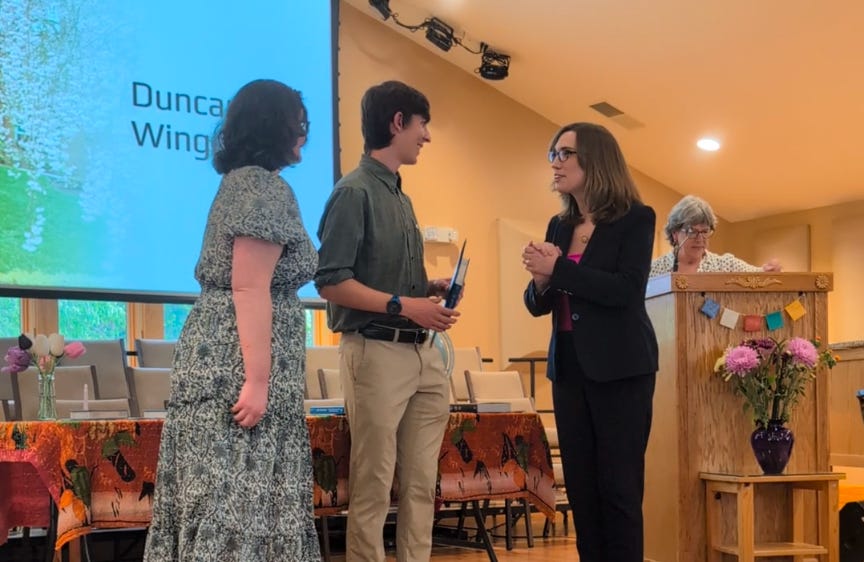
A Life in Balance
Honorable mention for the RENEW (Reflective Essays on Nature, Earth, and their Wonders) essay contest

A Life in Balance
I’d never known mother earth to be so ill. From my view up on the airplane, I could see her dead skin, that grey concrete, stretching for miles. Factories and CAFO’s were scattered like warts for as far as I could see. From up there, our sprawling human empire looked more like a bunch of worker ants, but worse. Even ants integrate into the world, but humans rule from above - seeking total domination. I wondered, why do we have to tear down one empire to build up our own?
That moment triggered a curiosity within me that led to a series of other questions. Why do humans try to elevate themselves above anything else - plants, animals, the environment, even each other? Upon reading Ishmael I realized something astounding. This pattern wasn’t innate within humanity, it was cultural. Before our unprecedented growth and increasing subjection of mother earth in only the past ten-thousand years, there were around 250-thousand years where humans lived integrated in nature. Countless cultural systems were built to live within nature, in balance. Their rituals offered penance not only to gods, but to the gods of nature and each individual’s connection with it.
One such group of people, the Native American Hopi tribe, have warned against the globalizing culture’s view of nature as something to be controlled. The chilling Hopi prophecy preserved throughout centuries predicts that the end of the fourth world is coming. It speaks of signs of the impending apocalypse, “snakes of iron / a giant spider web / rivers of stone that make pictures in the sun” (David). Upon hearing this, my mind instantly flashed back to my view on the plane. Railroad tracks. The web of electricity and power lines. Rivers of concrete, hazy under harsh sunlight. The prophecy is directly tied to the way we are building the world.
Hopi prophecy holds humanity accountable for its fate because it doesn’t try to predict exact dates but rather day-by-day practices that will lead to the end of human flourishing. We are given two paths forward, they say. We can perpetrate Koyaanisqatsi, “a life out of balance,” a zigzagging road upward, or we can trek a path one with nature. Ironically, when we chase the profit charts, thinking we are ascending to a greater destiny… we are really just expanding the calamity we’ll bring when we plummet back down to earth.
Whether jetting up and distancing ourselves from the earth, or climbing the social ladder, the only way this way of life survives is through ideology. It sinks its steel pincers deep into our minds, restructuring our thinking through regimented education. In schools, society teaches kids that if they dominate and scrounge their way to a position of power, they are entitled to keep taking as much as they want. We show them this through grading systems, popular media, and politics. If the way we teach them is from a position of hierarchy, they will slowly be indoctrinated into culture of Koyaanisqatsi.
With all this darkness and grey, what can we do? Suffice to say, the solution already slumbers within: It’s the hopeful perspective of youth.
I look into the bright eyes of a child as they explore nature, struck by awe at the sight of a bluebird. They stomp around with joy, each moment in the forest is a new adventure. Running through the woods, creating magical forts, rolling down grassy hills - this was me only 10 years ago. All along, there has been a free flowing spark of joy in the youth that wants to reconnect with nature, that sees nature as an extension of themselves. Youth is a blank slate, a dawning new tomorrow.
Just like trees, the youth require nutrients in their soil, clean air, and clean water. Their leaves will then contribute to the soil, they will draw from the sun, and they will give back to mother nature. Kids are not microchips to be stored with information, they are alive.
When we come to the crossroads, I believe all hope rests upon the youth. Their eyes, fresh and undisturbed, must look at the world and realize something is wrong. They must make a decision to respect and cooperate with mother earth, not dictate her. I must keep that 8-year-old child inside me alive at any cost, to keep playing and imagining and creating a new future. All of us still have the spark of youth within us, that hopeful way of looking at the world and reconnecting with our nature. It is the sacred duty of all of us to keep that hope alive, for it is the center that brings a balancing force of gravity to humanity.
The future is not written, and fate is not set. We create the future through not only our actions, but what we choose to believe and communicate to others. A cultural change can start in any moment, with the rituals and practices we choose to propagate, the way we frame our worldview, and the childlike hope we stubbornly protect deep in our soul.
After all, human nature is to be one with mother nature.
We can build our empire AND earth’s empire.
I hope, when I look down from the sky in 50 years from now I see skyscrapers of green, flowing rivers of blue, and homes of trees. Schools built within the trees, classes in forests, organic and living cities, freckles of colorful fruit gardens dispersed like stars. I can picture my children down there, building a relationship with mother nature that will become the foundation of our future. In that faraway world, my eyes wrinkle with joy, knowing that we took the right path.
I know whatever I do myself in these next years may be small. Conserving energy, planting gardens, building a solar-heated house. Through writing and filmmaking I raise awareness and create emotional impact. If people are able to see the real effects negligence has on the lives of actual people, we will be more inclined to act. We have many of the environmental solutions already, we just need a cultural shift that brings them into individual action and policy. And if, through communication, my generation can agree on this shared harmonious vision, we can create a world intertwined with nature that future generations can truly flourish in. We can create A Life in Balance.
Work Cited
“Koyaanisqatsi.” Francis Ford Coppola, Godfrey Reggio. https://watchdocumentaries.com/koyaanisqatsi/
Quinn, Daniel. Ishmael. Bantam Doubleday Dell Publishing Group, 1995.
David, Gary. “Hopi Prophecy and the End of the Fourth World - Part 1.” www.ancient-origins.net/myths-legends-americas/hopi-prophecy-and-end-fourth-world-part-1-002280.
David, Gary. “Hopi Prophecy and the End of the Fourth World - Part 2.” www.ancient-origins.net/myths-legends-americas/hopi-prophecy-and-end-fourth-world-part-2-002281.
I highly recommend any students eligible and interested in the environment should apply to next year’s RENEW competition!