Revisiting The Cave

It’s been 5 years since I was introduced to Plato’s Allegory of The Cave at philosophy camp, and I’ve been trying to live philosophy ever since. Today, I got to revisit the quaint little philosophy house once again, and this time the participants were k-12 science teachers in a workshop focused on how philosophy can enrich science classes.
(Allegory of the cave ted animation, if you’re unfamiliar)
Over the years, the cave had acquired a sense of familiarity and a warm place in my heart, but I hardly seriously revisited it with new eyes. I was excited that this time around sparked perhaps even more wonder and questions, based on what I have experienced and learned.
Now this is going to be chaotic, and probably make little sense, but I don’t particularly care. All I know is there’s something here and being perfectionistic is no help in exploring haha!
Hermeneutical Phenomenology is based on the assumption that we are born into a world of meanings and institutions and it is impossible for us to be born with a clean slate. Bias is inevitable. Rather than presupposing an objective “view from nowhere,” this research methodology is focused on noticing those “biases,” and being transparent about them (as opposed to simply “bracketing” them off, in a way still trying to take a pure objective view, like in phenomenology).
In a way, we are born into a cave built by others also in a cave. It is maybe more helpfully considered to be a series of catacombs that we crawl in and out of, sometimes occupying the same space, sometimes not. We are born with certain “shadows” that we take as reality, and phenomena which we name with the language that is handed down to us. The cave is our physical environment, cultural environment, and the people around us, all at once.
Now, would we try to deny that we are born in a cave at all? That there is at least some area, some gap in our understanding, for something? What I don’t like about plato’s allegory of the cave is that it frames enlightenment as being a sort of linear progression to the one source, Truth, if you will - the sun. But if you look for the allegory underneath the allegory you’ll see the line about the stars. Yes! There are millions of stars, and because of your position, this one is your light. But do not those other stars twinkle, with their light reaching us, even dimly? And if we were to fly far beyond this earth, wouldn’t they become our Truth, maybe even fundamentally changing things we take for granted as natural laws like gravity itself.
Furthermore, the ways we label things at all “shadows,” “trees,” etc. is a philosophical, a cultural choice. It depends on your measuring stick. You might say, oh- this is a tree! It starts at the top of its leaves and ends at the bottom of its roots. Ok, but what about the air constantly cycling through the tree, being integrated into it. Is the air part of the tree when it passes the threshold of the stoma? Or when it goes through photosynthesis? Furthermore, can this tree even be considered an individual when it relies upon the water, soil quality, bacteria, and climate to grow? Yes, it can be helpful to isolate a tree roughly by saying a tree is this point to this point, but that is only one measuring stick. You could also take a view of the tree as inseparable from the mycorrhizal network of fungi that connects various trees to illuminate the relationship trees and their network. The point is, there might be other measuring sticks that say something different and no less relevant, and it is the synthesis of all these measuring sticks at different scales that leads to holistic knowing.
Especially with humans there are iffy questions about the concept of “the individual.” Endosymbiotic theory tells us that there are mitochondria previously engulfed by other cells to work symbiotically which power our functioning and are entirely individual, functioning individual organisms with their own DNA. They reproduce independently, and are passed on from the mother. And let’s not talk about how every “individual” is a crazy mishmash of a collective of dna, food, ideas, culture, behaviors from people, etc. that is hardly consistent or unchanging, that shifts in different contexts.
So, that is where philosophy comes in. We need concepts for things before studying them. We need to sometimes draw lines where one thing is one thing and other ends. We need ways of seeing that give us different measuring sticks. Let’s say a bat was in the cave, and forced out. Do you think the bat would interpret the sun as the source of truth for everything? Perhaps it would value something else (sound waves?) that its senses show, that is invisible to us.
It turns out, we’re born into different caves, and we need each other first realize where we are so we can build infrastructures of culture, institutions, memories, and relationships that we’d want to leave behind for others, also born into caves. Perhaps we leave a map, a handy guide. We all have something to learn from each other, if we’re willing to sit with the discomfort of difference. A child can teach the meaning of curiosity and play. An adult might share experience or attention for detail that a young person lacks. We all have something to learn from each other, at any stage, and that goes for other organisms too.
Philosophy asks the bigger picture questions that science is a part of. They are not opposed. Science is a part of philosophy, and the scientific method unavoidably makes certain philosophical assumptions (replicability = truth, everything can be explained by material components that we break into parts to study, etc).
That’s not even mentioning that science itself exists within a societal ecosystem where there are grants, and real consequences with how it is used (or not). One thing I’ve learned from humanities research is that recognizing the agency of participants during something like oral history is vital to ensuring we are not extracting. The scientific process itself is not net neutral, the methods have impacts on the world. In the same way, treating research participants as static objects to be studied and not agents who do things threatens to strip their power and energy in the same way that we study nature. We have much to learn from the indigenous view of humans as a part, not separate from, nature, and our interdependence. We must think about these complex webs of effects, being open to learning from others who can see our blind spots, and think whether we are unintentionally causing harmful effects in pursuit of narrow truth that might not even end up benefiting anyone.
So, back to the cave. As I mentioned, I have lots of questions about the cave. In the allegory, the shadows were conveyed as false configurations of objects. They are two dimensional so lacking form, and lacking color. These are dimensions that are missing from the objects, in their oversimplification. But so too, if we would behold the original objects, and if the prisoners could hold it in their hand, they would see the form and color, but not things that only a microscope could see: the atomic makeup and the material of the objects. So too are they blind to how it got here: there is a history of the object. If they do not know how vases get made, there is a dimension they utterly fail to understand. Maybe the artist left their signature on the vase and the date, but they do not understand language, nor time, nor know this particular artist personally. These are all dimensions of knowing that even beholding the original object in the light of the sun, the prisoners would know nothing about. So, I ask: at what point can we, and can we even, make distinctions between these dimensions? When does 2D become 3D become 4D? When does literacy and meaning become part of the story, the information, of how that object got here? Can all of these dimensions even be explained by reductionist forms (ex: if we know absolutely everything about how atoms act, would we know these other dimensions? Would they even exist? Is the basic unit of matter, whatever it is, able to explain and cause everything: can neuroscience explain everything psychology can, and sociology, and political science?) This is to say, when does a particular way of seeing, a new dimension, become a shadow in itself, a false reduction only reflecting some other truth?
I have no answers. I can only promise questions. My other questions relate to my own personal experience. I have learned to trust my own experience more as a source of learning. It turns out, pure reason maybe needs to be balanced out by some intuition and reflection on what we experience. While “I know nothing,” like Socrates, I also know my present experience fully. It just is, in the Descartian sense, there is some thing that is experiencing something. I cannot articulate where it comes from, but I can trust that there is something there. My interpretations might be incorrect, and reason can help with that, but the experience just is, and it shows me something if I notice it. Perceiving is in a way co-creating the world. Now given that like most people I assume the world exists and others are conscious, I can learn from my own experience even more deeply and start to understand and empathize with others authentically.
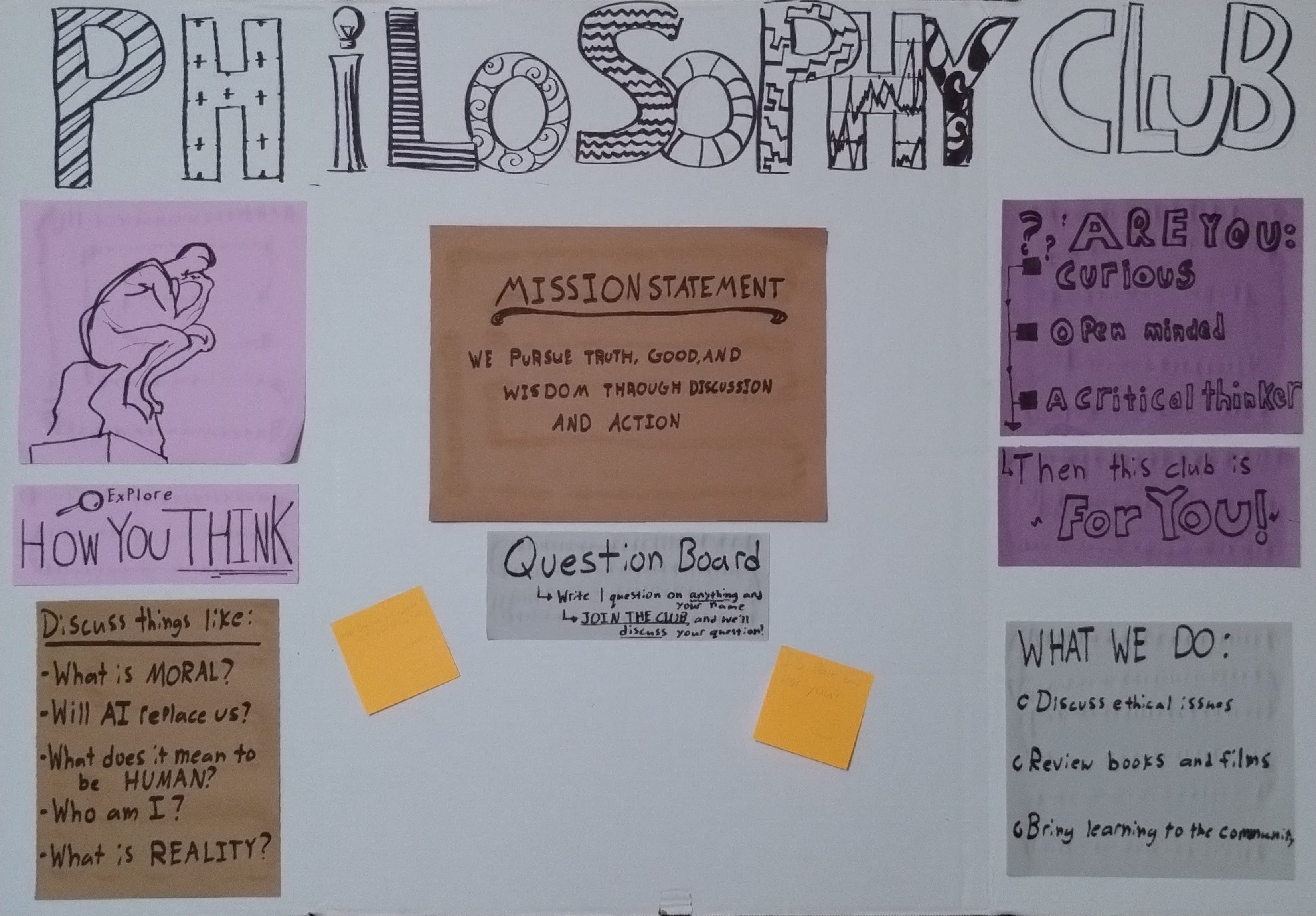
Now, what I have experienced feels like growth - rich and full - feels like flourishing, and I want that for others. It feels like escaping the cave, while gaining a humility that there are tons of other caves I’m stuck in. And as I question why I am the one in this particular situation, with experiences that showed me these different roads, like philosophy camp 5 years ago, or like the philosophy club my history teacher agreed to advise, or like the recent life-deepening strive leadership retreat I got to participate in at UMBC: I ask, why me?
One way of looking at is is that I was lucky. I was born into privilege, at the right places, at the right times. I was born with the right disposition and intelligence or whatever the heck that means. Perhaps that’s true. At the same time, something else is true: the actions of real people working hard in a line of mentors and human culture stretching for all of time led to this being possible. And if that is the case, then I too can create these spaces for those to follow. This opportunity and privilege may multiply, if I am a willing facilitator. And I just so happen to see that possibility, and have the privilege to pursue it, and it is aligned with everything I’ve seen about human thriving and what this world at this current moment is lacking.
This brings me to an inevitability: a way of life where I will constantly be misunderstood by people who say I have my head in the clouds and need to focus on realistic things, despite my intuition that we have confused metrics and accomplishments and performance for actual real change. In at least some sense, I see this other world, and this is the unique thing I can bring to the world. But so too do others see worlds that I can’t - I’m not special. It may actually be my role to facilitate the shift of certain habitual ways of viewing things so they themselves can unlock that hidden knowing within, things I even don’t get. I return to the idea: we need each other to see and escape the caves.
Still, there are elements of myself, or ways of seeing, or language, that are not welcome in this world and showing their full radiance would be blinding in the same sense of them looking at the sun. In a sense, I must re-learn to see the shadows, to understand how they see things, before I can understand how to invite them into a different kind of experience. Maybe they expect a room of shadows but there’s a magical little spark, and we name the experience with wonder, not with fear, and it sparks the gradual walking into the sun. Still, this world as it appears, the shadow world, is scary. It is not where I am myself, where I thrive. I am diminished, temporarily returned to chains. The question becomes: how does one retain the trust in their prior experience, the strength of their remembering, while returning to this world of shadow, so as not to lose themselves?
This is a question I will be exploring for the rest of my life. And it turns out, it is also yet another cave: it is a fear of mine to face the world as it appears without losing myself. I feel my energy and hope drain quickly, find myself forgetting the realness I had previously felt, as if severed from some life force. And subtly, if I’m not aware enough, or do not reflect enough, it becomes me.
My guess is that there needs to be a counterbalance to the world as it appears: spaces of attention and care and authenticity that are refreshing, revitalizing, those people who are united in their vision and hope, and only amplify the hope of each other. I also think being able to put ourselves into the future, or seeing the results of our work pay off in the slightest, brings a sort of energy. And experiencing spaces of appearance over and over will probably give clues as to when to retreat and rest up and when we can stay in it. Also, how we are orienting and moving our attention seems to matter: we can take solace by looking outward, looking for nuances, connecting that to our desire to learn.
It is the retreat, than the return, over and over. We leave the cave, bask in the sun, then return. And maybe, a prisoner inside the cave has learned how to make rope from roots, which you both take outside to the cliff-side you’ve been stuck on and make a bridge to a new island.
These teachers experienced a retreat from the hustle bustle of everyday life, enough time to be introduced to the wonders of philosophy. I can say that living through philosophy has truly catalyzed the flourishing of my inner, outer, and every aspect of my life. It has not been easy, and I’ve had my moments of doubt, and there are no doubt many more to come. But facing the fear does make it more tolerable, and makes the bright moments all the brighter. I’m nowhere near living out the extent of my values, but it is a dialogue and a process, and it is full and rich and meaningful and that’s all I could ask for.
5 years ago I asked myself, would you rather experience sharp discomfort now, or the slow degradation and sense of inner turmoil from living how you are called to?
I’m grateful for every single time I chose the discomfort. It gives me a present: the possibility to change.